Wednesday, May 19, 2010

Picnic Birthday Theme

Downtown.

Last year I lived in a different climate. Climate change is real.

Living near the North 45th parallel, the seasons are very defined. In that climate, I find myself asking, "Is this springtime?" If it is true, I can simply wait a few days and deduce, "Yes, this is springtime."

In Seoul--at least for this year--I recently found myself asking, "Was that springtime?" In reference to one Sunday where the sun was shining but I wasn't sweating.

Anyways, according to a brief look at wikipedia, springtime is the time between the three coldest months (winter) and the three warmest months (summer). Here, I think the average spring temperatures must resemble the average summer temperatures.

Picnic time.


On that fine Sunday afternoon, to commemorate the beginning of another fine year for another fine person, we once again hiked to a spot with a nice view and had a little nosh. On a clear day, you can see many of the major Seoul landmarks from one spot. The 63rd Building, Namsan Tower, Myeong Dong, Dongdaemun, and the Blue House. All while avoiding the crowds at the usual hiking spots.

Huge hula hoop.


On the way down, we noticed a few extremely large hula hoops and gave them a twirl. Against my initial expectation, the larger hoops are easier to move continuously.


Huge-la.


It wasn't my first time up there, and I'm hoping it won't be the last.

Monday, May 17, 2010

Sokcho Springtime Retreat

I don't much fancy big birthday to-do's so over the span of that weekend, I hit the road with a few friends on Friday night for a quick jaunt to Sokcho. Sokcho is a small coastal metropolis in the Northeast corner of South Korea. It is famous for deep fried/battered shrimp and a squid version of the ever so popular soondae, among other coastal cuisines; the mountains within Seoraksan Park; the beautiful autumn scenery; and to some, the House Hostel.

Daddy's pants.

It's very tempting to explore the variety of regions Korea has to offer in our limited time here, but places like Sokcho are hard to enjoy just once. The city provides plenty without overwhelming the opportunity to escape the constant bustle of Seoul. While the mountains are beyond explanation to those unfamiliar with Korea.

Our (my) primary objective on this trip was to walk to the top of the highest peak in the park, Daechongbongsan. It ranks third on the list of high altitudes in Korea, at a whopping 1708m. Three out of the four of us had successfully conquered this one in the fall, but were disappointed to sit in the clouds at the top. (Un)fortunately if I want to see the view, I'm going to have to return once more because this time the trailhead was closed due to fire season. Therefore we settled for the next greatest attraction in the park, Ulsanbawi. As disappointed as we were (some of us at least) at missing the opportunity to satisfy the primary objective, Ulsanbawi was, not in the slightest, a disappointment in the end.

As you can see, Koreans (nor the trail designers) are not afraid to use all means necessary to reach the top. Even if it means utilizing an erector set of metal stairs strapped to the side of a shear rock face. Its amazing to think someone, at some time, hauled all that up there.

Korean hiking.


It's not only hard to believe (for an American) the park doesn't require some kind of training to prevent serious lawsuits, but observing the strong will of the toddler aged to grandmothers who casually cruise up these stairs is phenomenal. In the end, the view was particularly excellent on that day, and so was the discovery of the Gorp infused peanut butter and jelly sandwich. (note: I'm not saying anyone here invented it, it was only discovered, like electricity.)

You can see the mountain we were hoping to climb the back ground. We all agreed in the end that the view of the top (Daechongbonsan) could be just as pleasing as the view from the top.

PBJ & Gorp.


Seoraksan Park.

Although the mountainous appeal of Seoraksan Park is enough, there is also an enormous Buddha, a gondola (for the lazy bones), and a variety of sweet dipped corn dogs. I went for the chocolate covered with sprinkles.


Buddha.


I would've thought most people probably make the trip to Sokcho to visit the mountains, but that may be an incorrect assumption. On a sunny Sunday, we covered quite a bit of the city by foot. It seems as though there are droves of people coming to the area for the food and smell of the fresh air. I can't say I blame them.

One of my favorite parts of this place is the abundance of these Tsunami barricades. All of which are formed using massive cement jacks stacked in neat rows which make very appealing patterns. Though alone they are still quite nice.

Tsunami Jacks.


The tell tale sign that Sunday's are popular in Sokcho is a long line at each end of this human powered ferry. For the equivalent of less than 20 cents US, you can take the ferry one way. There is a cable anchored to each side of the channel, and passengers can volunteer to pull the cable from one end of the ferry to the other, propelling the flat boat towards the other side. The alternative to taking the ferry is a really long walk. A functional tourist attraction.


Pull boat.


I'm not really sure why this picture is relevant, other than illustrating the quite atmosphere a foreigner can enjoy in Sokcho. Even though this particular individual lives on the "Hawaii of Korea."

Old Man and the Sea.


Surprising enough I managed to miss any opportunity to take a picture of the Cherry Blossom pandemonium in Seoul, which lasts the course of about a week. Luckily this one was locked up before it shed it's springtime mess.

Cherry Blossom.

Thursday, April 29, 2010

Jeju Do

I was lucky to have a school holiday on the second Friday of April. Because I was the only one I knew of with that time off, I took it upon myself to squeeze into an Eastar Jet flight and cruise down to 제주도 (Jeju Do).

Since Jonas, like the sorry sacks in Seoul, didn't have that Friday off, I caught the local bus up to the 성판악 trail head and climb Hallasan. When Jonas left me to go to work, clouds were over head and spitting a little. I was seriously questioning the necessity of climbing to the top, thinking it might just be a waterlogged walk through the clouds. But what else was I going to do? At the trail head I bought a cheap plastic poncho (just in case) and headed off through the gate. The nice lady at the gate window informed me that I had 2 hours to reach the checkpoint to the summit. She also mentioned that it usually takes 3 hours. "Nothing like a good challenge," I told her.

Although I was still a little groggy when I started to walk, my head quickly cleared up, and so did the cloudy sky. For about 5 minutes the sun started to break through the clouds and I thought I had made one of those great decisions in life against any odds. Unfortunately the feeling lasted about as long as the sun broke through. At any rate, rain or shine, I was outside breathing the Jeju air and getting some exercise. I mobbed up to the check point in 1.5 hours even with the school of middle school girls chatting me up along the way. I'm not always the best at taking time to enjoy scenery, especially when it's windy and foggy (i.e. no scenery). So when I reached the top of Korea I barely stopped long enough to take a picture of the trail sign.

The view from the top.


I took a different trail down from the one I took up. Jonas told me the views coming down the other side are great. Fortunately the

My shot vs. theirs.

clouds hindered the view just long enough for me to focus on the trail and not be distracted by beautiful scenery. The photo from the Yonggingak Shelter shows what I saw vs. what can be seen on a clear day. The poncho I bought wasn't necessary until just after I took that photo, until that time the rain hadn't picked up enough to warrant enhanced protection. I was glad to have learned why Gore-tex is such a popular product for NW Americans because that tarp got almost as wet on the inside from my own atmosphere.

I really like the feel of the sun coming through after a rain storm. It makes all the colors really stand out.

Sweet Sunshine.


Halla Mountain (한라산).


I think I have bad luck climbing the mountains in Korea. I have traveled to two of the highest peaks, and both times I climbed them in the clouds. It was just my luck that by the time I reached the bottom of the trail head, I turned around to see the top of the mountain. By the time I got back to Jonas's apartment, the clouds appeared to be avoiding the peak...

Seaside Villa.


Although the comforts of Seoul would be hard to pass up, if I had a choice to spend two years in Korea, I would definitely choose to spend one of them on Jeju island. Even though the rental allowance is only 80% of that in Seoul, the money goes much further. Jonas found a pension two blocks from the sea with twice the square footage for 100,000 won less than my apartment. Not only does he have a view of the sea from the front of his building, the view out the back is of Hallasan. Life on Jeju is much more laid back, the food and air is fresher, and to top it all off, you can easily find a 2 lane road with enough room to safely ride.


Green Grass.


One my favorite parts of Jonas's neighborhood is the surrounding grass fields. Each field is separated haphazardly by roads or stone walls which gives the area a rustic vintage European feel. When the sun begins to descend towards the horizon, the greens really stand out.


Egg Sack

This trip was a much needed break from the hustle and bustle. Among other things, I got to go golfing on an actual course, I climbed a mountain, and Jonas and I did some good old fashioned river bed exploring. We found a pond, possibly a swimming hole on the warmer days, threw some rocks, drank some beers, and found some strange egg sacks.

Back home I often spend the weekends out exploring with my friends. One of my favorite things is to go to rural parts of Oregon and wonder around, relaxing in isolated areas. Since I've been living in this metropolis, I haven't had any opportunities to do something this because there are so many people, there really isn't a secluded riverbed anywhere around.

제주도, I'll be back.

Friday, April 16, 2010

Easter Rising

For such a bustling, massively populated city, Seoul has a quite the spread of public parks. One of the more famous open spaces is Seoul Forest, which is a five minute walk from our apartment. The park use to be a horse racing track, but now has a water treatment facility, fields, equestrian area, wetlands, and fenced in dear among the many features. After our Easter Sunday divulgence, we took a walk through the forest and took some pictures. As you can see, it's not much of a forest because the trees aren't much older than 20 years. But it was a beautiful day, and as a rarity in Seoul, the sky was blue and you could see some clouds.

Seoul Forest.


Seoul Forest Geyser.


Seoul Forest Geyser part 2.


Seoul Forest old growth.

Monday, March 29, 2010

Borneo pt. 2

I resurfaced from the jungle to Kota Kinabalu before a two day hike up and down Mt. Kinabalu. The climb/hike consists of a slog

Almost close enough to touch.

most of the way up the mountain on the first day. At 3272m I stayed at Laban Rata, a full service resort so to speak. Throughout the course of the over night stay, we were served 3 meals: dinner, 2AM 'supper', and breakfast. All of which, including everything at the lodge short of the structure, has been hiked up by porters for a rate per Kg. These guys are crazy. On the balcony of the lodge, I witnessed one of the most beautiful sunsets of my life at the eye level of the clouds.

Sunrise from 4095m.

To reach the top by sunrise, we had to wake up, have 'supper', and be hiking by 3AM. The final climb to the top is not all that difficult, though the altitude is very obvious. The object is to reach the top right at sunrise so you don't have to sit up there and wait in the cold. We had a very steady ascent and timed it just right so that we made it virtually sweat-less. By the time I started feeling cold, the sun's warmth was coming over the ridge. If you look closely at the picture, you can see little specks on bright ridge line. Those are people.

Sunset at eye level.


I hadn't realized it at the time, partially because the day had been so long, but I saw the sun rise from the top of a mountain, and set into the South China Sea all in the same day. It actually took me until recently when I found the pictures in the same dated folder that this was the case. Vacation...It makes you forget some times. This sunset was enjoyed from the shore in Kota Kinabalu.


Just another day.

To top off my adventurous two weeks, I spent two days on the islands off the coast of Kota Kinabalu with some friends. It really takes a pair of swim trunks to find out how powerful the sun is near the equator. Back home, everyone sits in the sun for as long as possible, not very long. Here it seemed no one wanted full sun exposure for most of the day. The backs of my thighs learned why the hard way.

Indonesia pt. 1

Border patrol.


What'r you lookin at?

Over the course of six days, my guide and I walked two days in Malaysia, cross into Indonesia on the third day, walk for two days, and on the sixth day cross back into Malaysia. To my unfamiliar eyes, Indonesia did not seem at all different with the exception of the occasional flag. My guide told me Indonesian and Malay are very similar languages, so the people can communicate very easily. I think all these similarities speak to the history of this region. Although it spreads across the border of two different countries, the villages Kelabit Highlands are filled with relatives.

Helo!

Walking through the small villages of the Highlands, it is amazing to see the simplicity of life. It seems no one has a 9-5 work schedule-most people are self employed. Rice is the major export from the region, and the people are very proud of their product. Though this region may seem impoverished to a first-worlder, the people here live rich lives of simplicity. Instead of the PC Room, the children play with each other, and find entertainment in the simplest objects (as you can see with the tire). Imagine their surprise when they see a sunburned white man walk by their house...

Hard work.

As mentioned the rice-nasi-is a staple and main export for the Kelabit people. It's hard to find someone that doesn't own a rice padi somewhere. It is amazing to watch the process of harvesting the rice and preparing the padi for the next crop. There are no tractors or machines, everything is done by hand and machete. A man asked me why the English language has only one word for rice. I couldn't give him a very satisfying answer. In Malay, there is a word for rice when it's growing in the padi, a word for it when it's dry and ready to cook, and a word for it when it's on your plate.

Turn that one.

For teenagers, motor bikes in the highlands are the equivalent to cars in the States. In fact, the bikes are a source of income for teenagers. Since most airports in the highlands are not accessible by 4x4, supplies and people are ridden in on the back of these motor bikes. It's very impressive when you see the amount of building materials they didn't harvest from the jungle. Tin roofing, re-bar, cement, electrical materials, computers, etc. When not used for cargo, the kids fly around on them to impress their friends-of course they don't wear helmets.

Shreddin.


LTD.

I took many photos while walking through the jungle, but in the thick vegetation, I had a difficult time capturing a good perspective of the canopy overhead. This photo-I think-does the most justice to the sheer height of these trees. Being a native Oregonian, I have seen some big trees and a few thick forests. What I haven't seen is a tree so straight and so tall as many of these. The only vegetation on a particular species is at the canopy, so the rest of the tree is just a big, tall, smooth trunk.
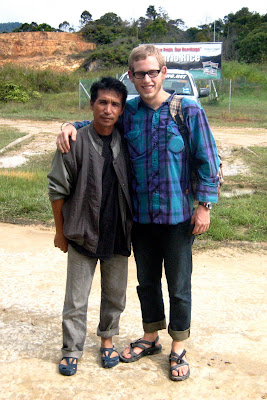
Blood brothers.


Although I hired him and had to pay him at the end, I felt like Reddi and I were just a couple friends going on a hike. He's a very skilled person in the jungle and knows a lot about the highlands. At one point I told him how much I envy his life, getting paid to walk through the jungle with tourists. He chuckled a bit and didn't seem to understand, but I think he's truly living the dream. There's no rat race in the highlands, no need for the pointless luxuries we struggle to afford. Instead it's all about the rice. Now where did I put that iphone?

Borneo pt. 1

Over the two week break between Korean school years (Chinese New Year) I took a trip down south to the island of Borneo. I spent most of my time on the Malaysian side, but stumbled over into Indonesia for a few days. I had the opportunity to spend a week walking through the Kelabit Highlands, in the jungle and through villages. It was great to see into the lives of the Kelabit people. Outside the highlands, I spent a few days in Kota Kinabalu and took the two day slog up and down Mt. Kinabalu. I have included some of my favorite shots and anecdotes from the trip.

To get into the highlands, I had to take three flights: Seoul>Kota Kinabalu>Miri>Bario. The flight from Miri to Bario was in a 15 seat Twin Otter turbo prop. Bario is 45 minutes inland by plane from Miri. Very soon after take off, the housing developments of Miri are replaced by the endless palm oil plantations occupying most of the territory between Miri and Bario. Admittedly, the plantations are a beautiful sight. But the view pales in comparison to the beautiful, diverse jungle these plantations have replaced. Something to consider next time you convert that old diesel... Enjoy the shot.

Biofuel for jungle.

Once I reached Bario, I arranged for a local guide to take me on a 6 day 5 night trek/village walk through the highlands. We spent our first night in the settlement Pa Lungan. While the home stay cooked us our delicious dinner, I took a short trip up to the top of a nearby hill. At the top someone had installed a chrome plated cross which allowed me the opportunity to get a photo in the reflection...

Well, Hello.


Big, puffy, and white.


...and capture the approaching shade.

Dinner?


A popular hobby/source of protein for the Kelabit people is hunting wild boar. Kelabit men spend a lot of time with their trained dogs out in the jungle slaying these beasts. This particular man shared his kill with a few houses in the village, a very common practice. Unfortunately curry was on the menu at the home stay, so I didn't get to try the pig. In this photo he is preparing to skin a hind leg.

The calm after the storm.

My guide was constantly telling me, "You have to finish the rice, or else it will rain tomorrow." The problem was, they always cooked way too much for me to finish the remainder. Needless to say I didn't finish the rice at dinner in Pa Lungan and shortly before bed time it rained. By morning the rain had passed and left in it's place a beautiful morning mist.